The story of Talia Byre is one of lineage, innovation, and resilience in the ever-evolving landscape of British fashion. It begins with a family tree, a rich tapestry woven with threads of successful clothes-makers, designers, and boutique owners spanning generations. Talia Lipkin-Connor, the founder and lead designer of the eponymous fashion label, sits in her East London studio, sketching out her heritage on paper. "So there were three brothers," she begins, drawing a horizontal line across the page. Her great-grandfather Saul and his brothers Sam and Campbell owned three tailoring shops across Liverpool between the 1930s and 1980s, collectively known as The Abrams Brothers. These shops were cornerstones of the Liverpudlian menswear scene, even attracting visits from The Beatles during their early shows at the city's legendary Cavern Club.
However, the passage of time has left little tangible evidence of this once-thriving business. Lipkin-Connor finds herself piecing together the story of her family's legacy, relying on anecdotes from her great aunts who chime in with memories from decades past. "It's like, 'No. That was 70 years before I was born,'" she says with a smile. Despite the challenges of reconstructing her family's history, Lipkin-Connor is deeply inspired by their legacy, which extends beyond The Abrams Brothers.
The family's success continued into the Swinging Sixties with her great-uncle Ralph, who made a name for himself in womenswear. In the mid-1960s, Ralph opened Lucinda Byre, a boutique in the heart of Liverpool that sold clothes from multiple brands, including miniskirt pioneer Mary Quant. The boutique expanded across the North of England and was one of the first to stock emerging designers like Vivienne Westwood and Mulberry. Lipkin-Connor recalls a film photograph of a shop assistant wearing a piece from Westwood's debut 1981 collection. Lucinda Byre also carried its own range of cashmere knitwear and shoes, remnants of which are now scattered across the wardrobes of extended family members. Some pieces have even found their way into vintage shops on London's historic Portobello Road.
The legacy of Lucinda Byre is so beloved that Lipkin-Connor has inherited some of its customers, who send her photos of their treasured garments and share happy memories. This connection to the past fuels Lipkin-Connor's determination to carve out her own place in the fashion world, despite the challenges of the modern British fashion landscape.
Today, the British fashion industry faces disruption in the wake of Brexit, compounded by rising studio costs, low industry wages, and a lack of government funding. Lipkin-Connor navigates this complex environment, discussing these challenges frequently with her family. "It's just harder," she says, referring to the difficulties of securing funding and accessing resources. Increased import and export tariffs, along with the scrapping of VAT refunds for tourists in the UK, have led several independent brands to relocate to Paris or Milan to ensure their survival. "It makes the UK very isolating," Lipkin-Connor notes, explaining that she uses manufacturers in Italy to avoid the hefty price tag associated with shipping to EU customers.
Following in her family's footsteps is no easy task. While clearing out her grandmother's apartment in Liverpool, Lipkin-Connor discovered rolls of fabric from heritage cloth merchants Dugdale Bros & Co., who had previously supplied the Abrams Brothers store. Hoping to do the same with her own label, she visited the UK-based supplier, which provided her with "loads of scraps and stuff." However, using British-based fabric has become unsustainable due to the high costs associated with shipping to Italy for production.
These challenges are at the forefront of the British fashion industry's concerns. Caroline Rush, the outgoing CEO of the British Fashion Council, used her opening speech at London Fashion Week to call for more investment and government support. "As we all know, it is challenging times," she told press, buyers, and other attendees. "Further support from our government is absolutely crucial... Our creativity is really the envy of the world; let's make our businesses that too."
Lipkin-Connor's new collection, presented during London Fashion Week, pays homage to items from Lucinda Byre. For example, she included a patterned Cacharel dress once bought from the shop and rediscovered by her mother. She also took inspiration from vintage knitwear, adding her own unique touches. "When I was in Liverpool, we found an old Mary Quant knit that used to be stocked at Lucinda Byre, which had this pocket detail. Then we were like, 'Oh, should we add a little pocket?'" she recalls. However, Lipkin-Connor is careful not to be overly influenced by the past. "It could very easily become too nostalgic, and that's not the point," she says. "Lucinda Byre was really forward-thinking... So it's really important that it still feels fresh."
Lipkin-Connor's ultimate goal is to revive the excitement of high street shopping through a bricks-and-mortar store. "People still crave that," she says. "There's nowhere, especially for me and my sister, where we'd go and shop in London." She envisions a multi-purpose space with a showroom, store, and atelier "that's got soul." When asked about potential additions to such a space, she laughs, "Someone the other day said we should have a wine bar." It could fit perfectly into her vision for a modern, yet deeply rooted, fashion experience.
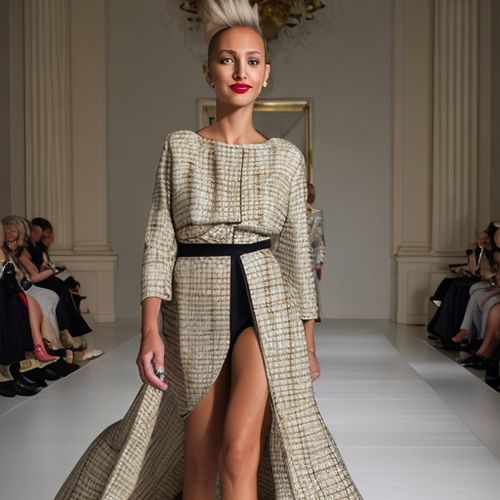
Talia Byre's offbeat approach to layering and unique styling, featuring barrel-sleeved shirts on bleached-brow models with black lips, feels distinctly contemporary. Yet, the label's intrinsic modernity coexists harmoniously with its deep, winding roots. Lipkin-Connor recognizes and embraces this duality. "The same woman that shopped at Lucinda Byre is the same woman that shops with us now," she says. "It's just a different period of time."
In a world where fashion is constantly evolving, Talia Byre stands as a testament to the enduring power of heritage and innovation. Lipkin-Connor's ability to blend the past with the present, to honor her family's legacy while forging her own path, is a rare and remarkable achievement. As she navigates the challenges of the modern fashion landscape, she does so with the knowledge that she is not just building a brand but continuing a legacy that spans generations.
By David Anderson/Apr 3, 2025

By Samuel Cooper/Apr 3, 2025
By Eric Ward/Apr 3, 2025

By Amanda Phillips/Apr 3, 2025

By Amanda Phillips/Apr 3, 2025

By Sophia Lewis/Apr 3, 2025

By George Bailey/Apr 3, 2025

By Sophia Lewis/Apr 3, 2025

By Laura Wilson/Apr 3, 2025
By Emily Johnson/Apr 3, 2025
By Jessica Lee/Feb 26, 2025
By Sarah Davis/Feb 26, 2025

By James Moore/Feb 26, 2025
By Noah Bell/Feb 26, 2025

By Noah Bell/Feb 26, 2025
By Daniel Scott/Feb 26, 2025

By Ryan Martin/Feb 26, 2025
By Victoria Gonzalez/Feb 26, 2025
By Benjamin Evans/Feb 26, 2025
By Lily Simpson/Feb 26, 2025